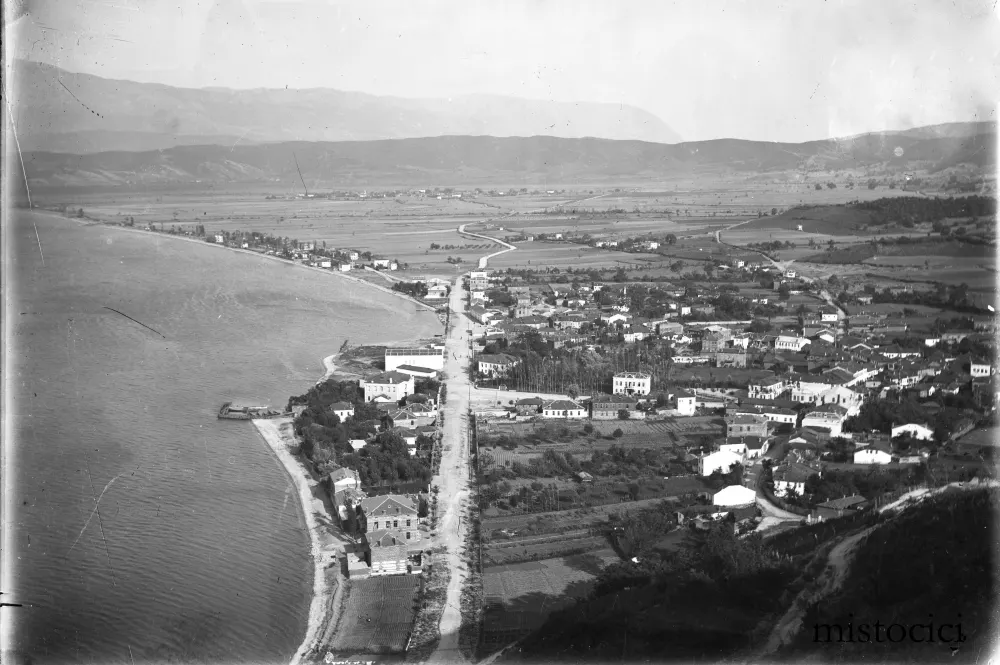
Discoveries made by archeological excavations show that the area of Pogradec has been inhabited since ancient times. Its population has its origins in the Early Neolithic period (6000 p.l.K) with settlements that stretched mainly along the lake shore.
During the Copper Period (3000-2100 BC) the number of settlements increased tremendously and expanded especially in the geographical plain where settlements are now established in hilly and mountainous provinces.
In the Bronze Age (2100 - 1200 BC), in the area of Pogradec, the phenomenon of fortification of settlements with stone walls appears. We have fortified settlements in the village of Blacë and in the village of Shpellë. These settlements continue to develop during the Iron Age (1200 - 500 p.l.K). In addition to the appearance of fortified settlements, during the Bronze and Iron Period the phenomenon of burial with mounds appears, which become the main way of burial until the eve of the Illyrian Civic period.
However, the greatest development in antiquity this region received during the Illyrian Civic period when it became the capital of the First Illyrian Kingdom (V-IV century BC). This territory was inhabited by the Illyrian tribes of Enkelej and Desaret, who are mentioned as tribes with state and military organization, as well as with a developed civilization and culture. They founded several important cities not only economically but also culturally. Among them, also identified in the field, we mention Pelion (Lower Selca) and Enkelana (Pogradec Castle).
In the first half of the century. II p.l.K, the territory of Pogradec fell under Roman rule. Nevertheless, this region maintained its economic development thanks to the construction of the Egnatia international road that connected Dyrrah with Constantinople, where the tributaries described the settlements along the lake shore and the province of Mokra.
In 359 AD, the Roman Empire split into two parts, the Roman and the Byzantine. The latter included the area of Pogradec.
In the IV - VI centuries AD began the first invasions of barbarian peoples who caused great economic, social and cultural damage to the territories where they passed. A number of populations such as Goths, Huns and Bulgarians moved to the Pogradec area, but the Slavs suffered the greatest damage, some of whom eventually settled in the eastern territories adjacent to the Pogradec area. Slavic invasions also influenced the deformation of settlement names. Thus, the settlement built under the Illyrian city of Enkelana was renamed by being Slavized in the Pogradec version which means "under the city".
The period of the century. IV - VI AD (also known as Late Antiquity), is also characterized by the mass spread of Christianity which, in 313 became the official religion of the Byzantine Empire where the territory of Pogradec was part. As a result, a large number of churches and basilicas began to be erected in this territory. Of these monuments, it is worth mentioning the basilica of Lin with its premises paved with colorful mosaics as well as with ecclesiastical and everyday life motifs.
At the beginning of the Middle Ages, the place was called Arbëri and over the centuries it was divided into principalities run by Albanian aristocratic families. Depending on the political circumstances, the territory of Pogradec was sometimes under the influence of the Balshaj family, sometimes under the influence of the Gropaj of Dibra and sometimes under the influence of the Muzakaj.
The division faded somewhat in the Skanderbeg era when our territory became part of the Arberian state led by Gjergj Kastrioti.
At the end of the century. XV - beginning of the century. XVI, the country was eventually conquered by the Ottomans. Already the High Gate divided Albania into four vilayets where each vilayet depended on several sanjaks. The area of Pogradec was part of the vilayet of Manastir and was under the direct subordination of the Ohrid sanjak.
With the proclamation of the Independence of Albania in 1912, the region of Pogradec becomes part of the new Albanian state and enters a new phase of development which was characterized by fluctuations conditioned by political circumstances, mainly due to the development of two world wars in the years 1914 - 1918 and 1939 - 1944.
With the end of the Second World War, the area of Pogradec became an important center of tourism but also of the mining industry.