Bloggers & Press 8 min read
Ardian Fezollari, lyricist of the photographic landscape
By Qerim Vrioni – In the history of world photography, landscapes and portraits are the two earliest genres, practised since the very first masters of the craft. Among the oldest, we note the (urban) landscape by the Frenchman Louis-Jacques Daguerre entitled “View of the Boulevard du Temple” (1838) and the natural landscape by the Englishman William Fox-Talbot entitled “Some Trees” (1842) – not by chance, these two are also the most important inventors of photography. In natural landscapes, people and their handiwork generally do not appear, whereas urban landscapes also show buildings, bridges and roads – in other words, everything made by human hands.
Later, as technological processes advanced, the photographic landscape began to appear more and more in the portfolios of the masters of the “darkroom”, always in black and white, of course. Towards the end of the 19th century, photographers with artistic ambitions sought to create landscapes resembling those of painters, giving shape to the movement known as Pictorialism, which lasted until the early 20th century, when it ran out of steam. Then, from the 1920s, the American photographer Ansel Adams stood out for his natural landscapes of his native land, giving landscape photography new weight.
Since then, landscape has been widely practised by photographers from almost every country in the world: exhibitions and competitions are devoted to it, there are periodicals, and albums are published, in colour as well as black and white.
In Albania, as far as is known to date, the earliest landscapes historically include shots by Kristo Shuli, Thimi Raci, Kel Marubi, Kristaq Sotiri, Misto Cici, Ymer Bali and, above all, Shan Pici, who stands out both for the large number of views of nature (especially of the Northern Albanian Alps) that he fixed on photographic paper and for their quality. Even so, it is thought that some of these masters produced their landscapes for postcards. During the second half of the 1900s, the country saw the particular development of the urban landscape – or, as socialist realism labelled it, the industrial landscape – which, as pure propaganda, depicted the construction of works such as factories, hydroelectric power stations, bridges, roads and tunnels, in order to display the grandeur of the communist dictatorship. These landscapes filled the pages of the party-state press, taken by photojournalists of ATSH and of the newspapers and magazines of the time; some had aesthetic merit, although figurative agitation was their primary purpose. Only occasionally during that period was a natural landscape published, in colour or in black and white.
At the turn of the 20th and 21st centuries, landscape (especially natural landscape) was practised in our country by a good many photographers, among the most successful of whom we mention Leon Çika, Zamir Marika and Nikolin Baba, while from Kosovo we note Afrim Spahiu, Naim Shala and Fahredin Spahija. In the front rank of landscape photographers of the Republic of Albania, Pogradec-born Ardian Fezollari also holds his well-deserved place.
In 1994, after graduating from the Police Academy as a forensic expert, he began to take up photography seriously as a passion, or hobby. In fact, his profession as a forensic investigator also required the use of the camera as one of the compulsory disciplines of the job. Nevertheless, we believe that the more decisive factor in pursuing his passion for the “darkroom” was the rare, painterly landscape of Pogradec, the town on the most beautiful lake in the Balkans. And so he works as an officer, but never for a moment without a camera over his shoulder, ready to capture landscapes.
In 1996, Ardi Fezollari held his first solo photography exhibition, which was well received by Pogradec's art-loving public. His dedication to photography now became a strong passion for the criminal police officer, and recognition was not long in coming. In 2000, he was awarded Third Prize at the National Tourism Agency exhibition, which raised his own standards for ever more aesthetically accomplished photographs. Meanwhile, he took part in various photography exhibitions abroad, in North Macedonia, Bulgaria, Austria, Egypt, Denmark and elsewhere, sometimes representing himself and sometimes his country. In 2006, Ardi Fezollari came before the public with a serious publication entitled “Landscape”, a large-format album printed on quality paper – but above all, it was the photographs in the album that were of real quality.
Photographic landscapes of Pogradec had already been made from the 1920s onwards by the master of the camera Misto Cici (1902–1981), some of which were printed as postcards (in black and white) in Italy for the domestic and foreign markets. So photographing the nature of the town and the lake, to immortalise it on paper, was not something done for the first time in recent years. Perhaps Fezollari also benefited from the experience of Cici's landscapes, but he has taken their quality to a higher level – and not, of course, merely thanks to the technological advantages of today.
For several years in a row, on his own initiative, Ardi Fezollari organised “Photography Days” in Pogradec, with camera artists from all over the country and even from Kosovo and North Macedonia – one of the rare events that bring them together. At these events, the invited masters of the camera exhibited their photographs and exchanged personal experiences.
But what drove Ardi Fezollari to devote himself so passionately (and, we would say, so successfully) to photography as well (especially landscape), alongside his work as a forensic expert? A hasty answer would be his familiarity with photography and the camera as part of his duties as a qualified officer. If that were the whole answer, every police station would have landscape photographers well known in the Albanian photographic world, which is not the case. The main factor, I believe, was the special nature of Pogradec with its blessed lake. Nor should we fail to mention the encouragement Ardian Fezollari received to delve deeply and continue tirelessly in the field of photography from his drawing teacher, the late Pogradec painter Skënder Lako.
Fezollari's landscapes are generally in colour, just as nature is, which he photographs as an ardent lover, feeling a sense of release in the tip of his index finger every time he presses the shutter. His favourite seasons in Pogradec are autumn and winter. That does not mean his camera gathers rust in spring and summer. Far from it: he takes photographs almost every day, starting in the morning on the 50-kilometre drive to work, which he covers with stops forced upon him by the painterly views caught by his eye, trained to tell the beautiful from the ordinary. And naturally on the way home from work, too, especially in the afternoon and evening, when the light is soft, low and slanting, he stops the car again and… starts photographing.
So where does the distinctive value of Ardian's landscapes lie? First, in finding what is unique and placing it within the rectangle of the frame – something an ordinary eye does not notice. Added to this is his ability to visualise in advance how the landscape will appear on photographic paper, long before the lab carries out that process. Likewise, as an artist, he aims – and succeeds – to capture within a fleeting moment a motif in the photograph that will convey something to viewers when they see it, not only aesthetic messages, although these are paramount in Fezollari's work. This careful choice of motif sets his landscapes apart from the postcard-style images so common when it comes to photographing places of striking natural beauty. It is true, as we have said, that Pogradec inspired Ardian Fezollari to photograph it, but is it only his own town, the lake and its surroundings that he knows how to photograph? His years of experience refute this idea. He has also photographed natural and urban landscapes abroad (and in Pogradec, of course), for example in Florence (Italy), with which he also held a dedicated exhibition, received with curiosity and delight by Italians.
In general, he takes part with the finest selection of his work in every photography event that is organised, not only in Albania but also in Kosovo and North Macedonia. Looking closely at Fezollari's photographic landscapes, one could say that they contain “invisible poetic filigree”, a sure sign of the poet's soul of the Pogradec photographer. As mentioned above, he continues with dedication to produce aesthetically accomplished photographs that are warmly received by the public.
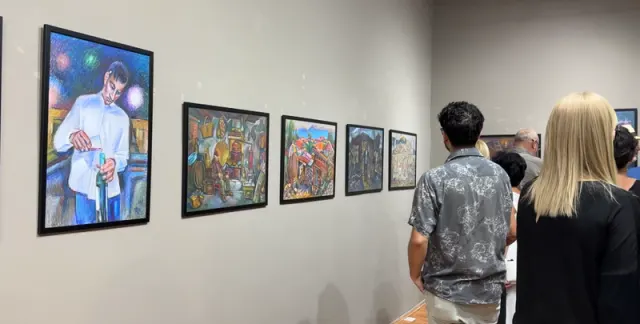
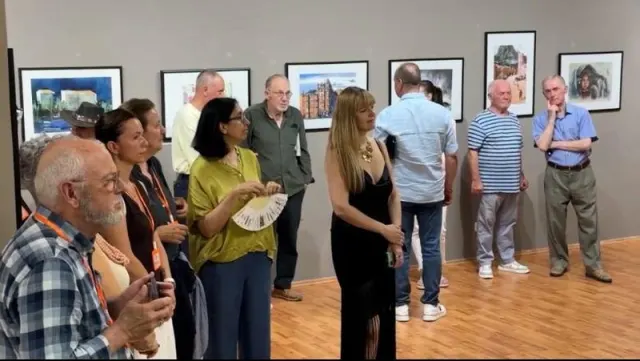
Fezollari's latest photography exhibition abroad opened 3–4 months ago (18 December 2018) in Bucharest (Romania), entitled “Albania, the Poetics of Space”; it was inaugurated with a ceremony, visited by many photography lovers and covered by the local media. The very apt title of the exhibition also captures the essence of his photographic work – in other words, the leitmotif of Ardian Fezollari's landscapes, created with such love on photographic paper. He thus remains one of Albania's most distinguished virtuosos of the camera when it comes to capturing landscape.