Bloggers & Press 14 min read
Artan Fuga/A report by Artan Fuga/ Culture in the town and what I saw in Pogradec
I have always been interested in archaeology. Not the archaeology of what lies underground, though. Nor that of the sky. Rather, the archaeology of horizons, the place where the line of the land, natural or built, meets the world of the sky. Ever since I studied the philosopher Heidegger, one thing has stayed with me: he explained in one of his lectures that the ancient Athenians perhaps saw the same relief and the same horizon as we do, but for them it had a different meaning; they experienced it differently. How did the ancients experience the horizon and the landscape? This question comes to me whenever I find myself in a city, be it Berlin, London or Paris.
How did the ancients experience the horizon in Pogradec? This question comes to me every time I step out onto the balcony of my room at the "Pogradec 2" hotel, where you never tire of savouring the comfort and pleasure that everything there gives you. Pogradec has surely preserved the line of the horizon above the lake as it was in the time of the ancient Enchele, perhaps the mountain and surrounding hills too. The skyline and landscape of a settlement are a precious archaeological and environmental asset. They must be protected from buildings that scratch at them. A cultured people does not fill the sky with apartment blocks, stakes and towers that rob it of the sun, the moon and the sunrise.
Ah, when the sun rises and turns the whole lake to silver!
The skyline and landscape of a town are not only of aesthetic value but also of economic value and a matter of survival. Those who settled there knew the relationship between the vegetation, the forest, the mountain peaks, the lake and so on. If you spoil one of the structuring lines of a town, such as its coastline, its riverbank or its horizon, you have touched what should not be touched. You have disturbed the snake where it sleeps.
But lately, for a few decades now, in the frenzy of construction and the passion for easy money and plunder, we have been treading on rotten planks.
I look over towards the entrance to the town and notice that the vegetation on the hill above the road has been stripped away. An ugly sight. The whole carpet of hills and mountains around the town is green, almost untouched apart from a few places, but there, above the road, where the access road into Pogradec is being widened, the sight hurts your eyes: giant excavators gouge the hill, devour the vegetation and shrubs, and the hill's material is torn from a shape that is who knows how many centuries old. What is going on here, gentlemen?!
I go to the entrance of the town, since it is on my way. I park the car in a lay-by at the building site. I move closer to take photographs. The giant excavator, a dragon, is devouring the hill with all its centuries-old green vegetation. I had never seen such an environmental massacre.
Ever since I had spotted the ugly blot from the hotel balcony, I had been crying out: who is ruining and tearing up the green carpet of this tourist town like that? Who is robbing Pogradec of the beauty of its landscape and its skyline, just to widen a road?
"Oh, give it a rest!" a friend from Pogradec told me. "Don't start playing road engineer as well. The road there is being widened by cutting into the hill and its long-established vegetation, so that the hill doesn't slide onto the new road. The pillars that will hold up a kind of panoramic tunnel will protect the road so that boulders and masses of earth don't fall on it!"
So be it, but that blot like a bald head stripped of vegetation, and those giant excavators devouring the hills and green spaces, have shaken me. The green carpet all around Pogradec has been torn.
As soon as I get out of the car and start photographing the giant excavator, working on a slope of almost 45 degrees and passing the earth, tuff or rock from the hill to even more gigantic lorries, filling their trailers, a head in a hard hat pops out of the tunnel and whistles at me:
"Fiuuuuuuu!"
I look at him in surprise.
"What's the matter with you?" "What are you photographing for?" the head in the hard hat shouts at me threateningly.
"Look, sir, I'm photographing the hill and the landscape for my own pleasure. What's it to you? Is it your hill or something?"
He mutters something to himself and shakes his head, his hands, his finger.
What a fool! Anyway, I leave rather quickly, because I'm afraid a team of men will come out of the tunnel, grab me and wall me up underground like Rozafa in the castle. And then the hill would hold firm!
Well, I ask myself, couldn't they have diverted the road a little, setting it on pillars over the tunnel, instead of gouging out the hill?
Perhaps they had no other way, who knows! I am no specialist. But not even the devil and his son could convince me that a gouged hill, stripped of its vegetation, will not slide a thousand times more than when the earth and rock are held together by the roots of trees and shrubs that are many, many years old.
In Durrës I have seen how, during heavy rain, the whole western face of the hill at Currila, facing the sea, slid and fell onto the yards and roofs of houses and onto the road. A horrifying sight.
A great responsibility lies with the specialists who drew up the project in Pogradec, and how I wish an environmental disaster were not being prepared here as it has been elsewhere.
I return to town and, to pull myself together, go into the old "Turizmi" hotel. A sheqerpare, the syrup-soaked pastry that they really know how to make, and only that, settles my stomach a little. I feel sick. The town's centuries-old green carpet is being gnawed by giant rodents that have got into the house. Aesthetics is finished, and as for urban planning, let us see whether it manages to rise above the grave of its twin sister, aesthetics.
I eat the sheqerpare and my gaze melts into the lake. A summer shower has just fallen and the sun has come out again in triumph. It is still shining before it sets.
I remember that Pogradec once had an even older tourist hotel. With a refined, aristocratic taste. Surrounded by trees, with a flower garden in front and a café and pastry shop whose beauty, sadly, the younger generations know nothing about. With mirrors and large windows. Unbelievably cool in summer. In the evenings the Pogradec light music orchestra played there. I was very young in those years. I remember there were brothers among the musicians. Virtuosos. I have a memory that some of them were blond. Or perhaps it was a play of light, a reflection of the gold of the instruments on the faces, bodies and hair of the orchestra members. The whole town never missed a chance to come and enjoy their art. Pogradec light song, serenades, and Albanian and foreign light music in general rang out, played with virtuosity and sung with mastery.
The beer flowed non-stop!
There is relatively little music and song in Pogradec today, and it is a pity. Somewhere over by Drilon, three years ago, I heard a CD of Pogradec serenades in a bar on a platform over the lake. One of those small places full of charm where, in the morning at sunrise or in the evening when the sun sets, you are seized by the magic of becoming one with the mountains and hills, with the water and the willows, melting in thought and feeling into the coffee, ice cream or semifreddo you are enjoying, wanting for nothing in the world.
Three years ago I said to the waiter:
"Would you let me have this CD of Pogradec serenades? I'll buy it for whatever it cost."
With the nobility and generosity of a true Pogradec man, he answered on the spot:
"Take it, I'll find another one! Five hundred lek."
For three years I have not taken that CD out of my car radio. It plays over and over again; sometimes it sticks, screeches, cuts out. But it brings Pogradec to my imagination, that corner where my ears first heard those sounds.
Now, three years later, I pass by there every evening. I am a little disappointed, because it is the same CD being played all over that area:
I took the knife to cut the apple,
Jorgjica, Jorgjica,
it slipped and I cut my hand,
Jorgjica, Jorgjica.
These people here are also playing the same single note on the flute, just like me in my car, I said, laughing to myself. I didn't go there again.
When a colleague travelled with me in my car for about three hours, he didn't say a word, even though the Pogradec CD started again from the beginning every twenty kilometres. Only at the end of the journey did he quip, jokingly: "Professor, you're driving us mad, man. Haven't you got any other music?"
And I, also with humour: "My dear sir, in this old car you've climbed into, what do you expect, a varied playlist?"
Still, you are quietly grateful that it is the private sector which plays a little music in its restaurants, perhaps more at weekends, because otherwise you would feel you were in the Pogradec of silence.
Jorgjica, Jorgjica! Oh, heaven help me
I remember that in our youth we used to watch films at the town cinema. How delightful it was! Now there is not even a shadow of it. Television has perhaps wreaked havoc. I imagine the town with a large stage in the centre where, live, every day, there would be the music of the area, light music, with artists and singers from all over Albania, Macedonia, Greece and so on performing. Who doesn't come to Pogradec! A blessed place that keeps silent!
Theatre?
Go and look at the monument to Auntie Ollga in Tushemisht!
Variety shows or cabaret?
Oh, go and watch the summer reruns of "Portokallia". We Albanians can't do better than that!
Perhaps the sociology of the holidaymakers is such that they rejoice more in silence than in the cheerful sounds of folk dance, rock or dancing in general.
The town, its sounds and its holidaymakers form a single whole. They are in harmony. A cynic would say that the pot has found its lid!
Traditionally, Pogradec has had the image of a resort for holidaymakers of the third, or even the fourth, age. From the 1980s onwards, in Tirana circles there were intellectuals who holidayed in Pogradec, as Enver did. Just as today there are senior officials who holiday wherever the head of the executive holidays. They follow him around. Like courtiers once followed the King of France. They turn up in front of him even on holiday.
Leading intellectuals of the time, of a certain age, came to Pogradec for the summer. Like rams taken up to summer pastures. They rested in peace and quiet to refresh minds tired partly by age and partly by the pressure of the regime, since there was no money in those days. Those of us in Tirana waited for them to return with works, books, creations.
The Leader would come back from Pogradec having uncovered hostile groups, as the documents of the time attest!
In Pogradec you also see families, as well as people who are not very fond of the scorching, blazing sun of the seaside. Some of them, like me, for example, also have blood pressure problems and keep out of the sun.
This population, understandably, seeks peace and quiet rather than music and liveliness. As the great Heidegger wrote, and I don't know whether he is known in Pogradec, the dwelling, the dweller and the manner of dwelling are the same thing. They are one! But this population dampens the town's liveliness. Meanwhile, the town needs consumption. So there could well be two Pogradecs: one for the quiet tourist demographic and another that, with its own vitality, keeps the town alive.
Pogradec cannot be turned into a boarding school, nor a monastery, nor some kind of hospital associated with the formula and slogan: Please keep quiet! Or: Silence heals! No cinema!
No theatre!
No cabaret!
No concert!
I couldn't see any!
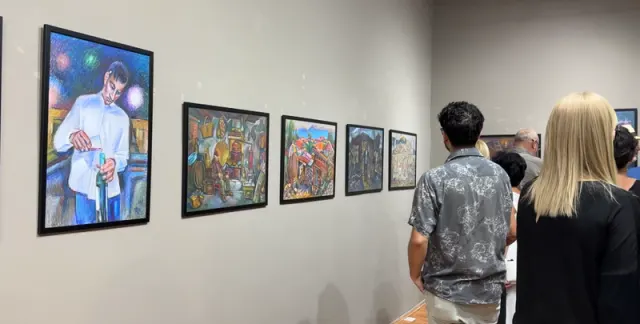
Someone tells me that Pogradec has a good school of painters. I believe it and am greatly enthused by this information. My friends and family tell me about famous and talented painters such as Vangjo Vasili and Anastas Kostandini. I want to find out which school of painting they belong to. I imagine, as a member of my family tells me, that besides their own art, they are surely influenced by the transparency of the local landscape, a harmony of nature whose interplay of water, sun and shadow surely makes it possible to create an artistic universe that only great talents like theirs could create.
"Where do they exhibit their work?" I ask, hungry and passionate.
"Generally in their own homes!"
That's not bad, but painters like them, as well as others who are younger, so I am told, need to be promoted, to have their works shown in studios and galleries, so that they do not have to know the struggles of painters in Tirana, who have to subsidise their own relationship with the public.
Why not an art gallery made entirely of glass, facing the lake? There the art of nature could compete with the art of man. Let us see who would win this great contest between matter and spirit, a pair that the great pantheists have argued is in fact a single, unique whole.
For now, how nice that there are rides for children in the lakeside garden. The train, the cars of a mini go-kart track, little toy motorbikes and so on. And the good pensioners of Pogradec playing dominoes without looking up.
My foreign friend tells me, laughing: "This is where I'll find you in a few years!"
I reply to this joke, which had me in stitches, with a serious sentence: "That would be the best outcome!"
The town's domino academy!
But is there a proper library? On the pavement, two or three small stalls where booksellers have come from Tirana to sell their books and publications. That is the extent of the town's culture in summer. I mean street culture. Street culture! What more could you want?
I chat with the booksellers, because some of them are my friends and I respect them for the work they do. They are promoters of written culture, not just book traders! It is an honour for Pogradec to have these newcomers among its people.
But I think: hasn't this Ministry of Culture, which has put up a small subsidy to bring booksellers to Pogradec, considered for a moment that in this way it is turning the town's bookshop into a ruin? Doesn't it distort competition???
Not that the Ministry of Culture understands anything about the economic logic of the creative industries! Or about competition in the cultural market!
It does whatever pops into some official's head!
It's sweltering now!
The rides are a bit naive. There are no swing boats that rock powerfully. The go-kart track, run by a few dynamic men in town, still doesn't have as many customers as it should.
The children of the town and of the holidaymakers should be encouraged to come to educational play. For example, by offering a "children's licence" product, where every little boy or girl, over three weeks in the summer, could earn a child's licence to ride a motorbike, drive a car and so on. And why not, schools could base pupils' road safety education, from an early age, on the infrastructure of the town's go-kart track.
Thank goodness it exists!
I look for tennis courts!
Basketball courts!
Five-a-side football in town!
I look for a pool for swimming races!
There used to be sports grounds at the Pioneers' Camp. There used to be a lovely stadium, because Pogradec had a football club with an endearing team. It went up and down from the First Division, but the big teams left their bones behind in Pogradec.
And now culture in the town sits in the shade like a pensioner suffering from high blood pressure.
Now:
Jorgjica,
Jorgjica, I took the knife,
To cut the apple,
It slipped and I cut my hand!/